
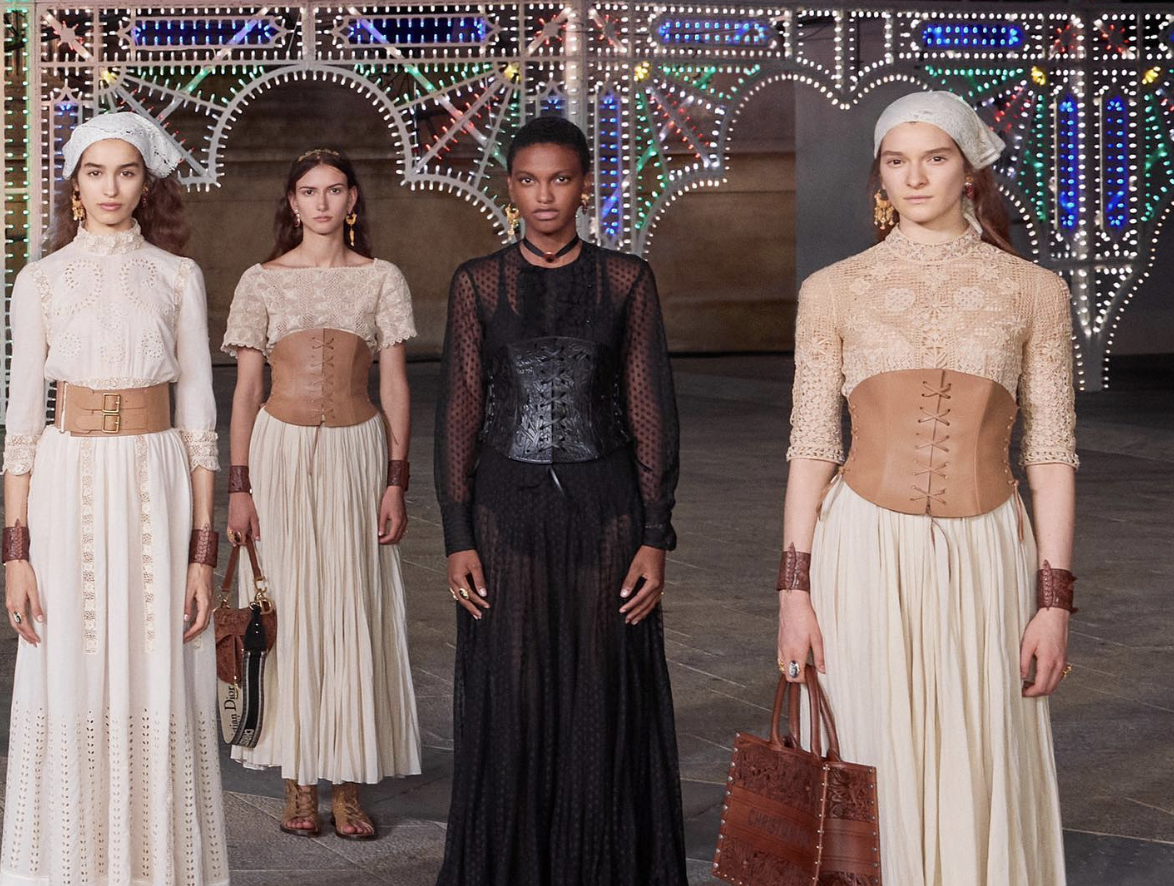
La Notte della Taranta has been healing people through sound for five centuries. Fashion just caught up.
In July 2020, in the middle of a pandemic with no audience permitted, Dior brought its Cruise 2021 collection to Piazza del Duomo in Lecce. The creative director Maria Grazia Chiuri, whose family roots are from Tricase in Salento, had spent months thinking about what the soundtrack should be. She chose the Orchestra Popolare della Notte della Taranta. Not a playlist. Not a commissioned score. The actual orchestra of one of the most ancient and extraordinary musical traditions in Europe, the pizzica of Salento, rooted in centuries of ritual, exorcism and the idea that music could do what medicine could not.
The models moved through the baroque piazza to the sound of tambourines and accordions and voices carrying a rhythm that has existed in these villages since the 11th century. Pizzica dancers performed alongside them. Over 240,000 people watched online within hours. Chiuri understood something that fashion is slowly learning, that Salento is not a backdrop. It is a culture with its own sound, its own history, its own relationship between music and the body that predates every conversation we are currently having about wellness, ritual and release.
That sound is La Notte della Taranta. And if you have not been, you should go.
The story starts with a spider bite. Or rather, with the belief in one. For centuries, women working in Salento’s fields during summer would collapse. The symptoms were hysteria, anxiety, physical agitation, a kind of possession that the community attributed to the bite of the tarantula. Modern anthropologists have proposed other explanations. The particular condition of women in a rural, patriarchal society with no sanctioned outlet for suffering. Depression. Psychological distress with nowhere to go. But the cure, regardless of the cause, was always music.
A fast, rhythmic, insistent folk music played on tambourines, accordion, violin and guitar. The afflicted woman, the tarantata, would be placed at the centre of a ritual space and the musicians would play for her, sometimes for days, until she danced herself to exhaustion and whatever the poison was, real or metaphorical, was spent. What is extraordinary about this is not the spider. It is the idea underneath the spider. That music could reach somewhere medicine could not. That sound, specifically rhythm, could move through a body and pull something out of it. That dancing to the point of collapse was not madness but treatment.
The Church was uncomfortable with this for obvious reasons. By the 1960s the ritual had faded. The anthropologist Ernesto de Martino, who documented it in the 1950s, understood he was recording something at the point of extinction. But the music survived. Pizzica carried forward the rhythms and the intensity. What had been private suffering became public celebration. What had been cure became dance.
August in Salento
In August 1998, in the tiny square of Melpignano, a village of fewer than 2,000 people in the heart of Salento, the first La Notte della Taranta was held. The square was too small for the audience that came. A black and white photograph of that night hangs in the Mayor’s office. Nobody had quite expected it.
Twenty-seven years later it is one of the largest folk music festivals in Europe. The final Concertone in Melpignano draws over 200,000 people. The festival tours across 20 village stages throughout August before culminating in that final night, the Orchestra Popolare, a guest Maestro Concertatore reimagining the traditional repertoire, and a crowd that has been building toward this moment for weeks. The guest directors tell you how seriously this festival is regarded. Joe Zawinul in 2000. Stewart Copeland of The Police in 2003. Ludovico Einaudi for two consecutive editions, an experience that became his 2015 album Taranta Project. Goran Bregovic in 2012. Each of them brought something from outside and proved that this music is not a museum piece. It is a living language that absorbs everything without losing itself.
There is a moment at La Notte della Taranta when something shifts. The tambourines have been playing for hours. The crowd, which has been moving steadily and almost without deciding to, begins to move as one. The music does not build in the way you expect music to build. It simply becomes more itself, faster, more insistent, more ancient. You understand, in your body rather than your head, why people once believed this sound could heal you.
The travelling festival, playing across 20 village squares in the weeks before the Concertone, is where this feeling is most concentrated. A small piazza in Corigliano d’Otranto at midnight. A few thousand people. Musicians who have been playing this music since childhood. The tambourine rhythm bouncing off medieval stone walls. It is one of the most singular experiences in European music and almost nobody outside Italy knows it exists.
The Dior show was not the only moment Salento and fashion have intersected around this music. At Palazzo Luce, the extraordinary seven-suite art hotel in the baroque heart of Lecce, two minutes from the same piazza where Chiuri held her show, guests are invited to an exclusive evening performance of the Taranta. The same Paolo Buonvino who directed the Orchestra for Dior composed the music. The same dancers who performed at the fashion show perform on the Palazzo’s terrace, under the green neon light of a Joseph Kosuth artwork, to an audience of just the hotel’s guests. It is fashion and music and history converging in a way that does not happen anywhere else in the world quite like this.
The festival runs every August, touring the villages of Salento before the Concertone on the final Saturday of August. Lecce is your base, baroque, beautiful, increasingly a city that knows exactly what it is. Palazzo Luce for the full editorial experience, bookable via Booking.com, or the surrounding masserie for something more immersed in the countryside. Book early. Puglia in August is not a secret anymore.
Before you go, listen. Start with Canzoniere Grecanico Salentino, central to the festival since its beginning. Then Ludovico Einaudi’s Taranta Project on Spotify or Apple Music. Paolo Buonvino’s Taranta Reimagined for the Dior and Palazzo Luce connection. Your body will start responding before your mind catches up.
That is the point. That has always been the point.