
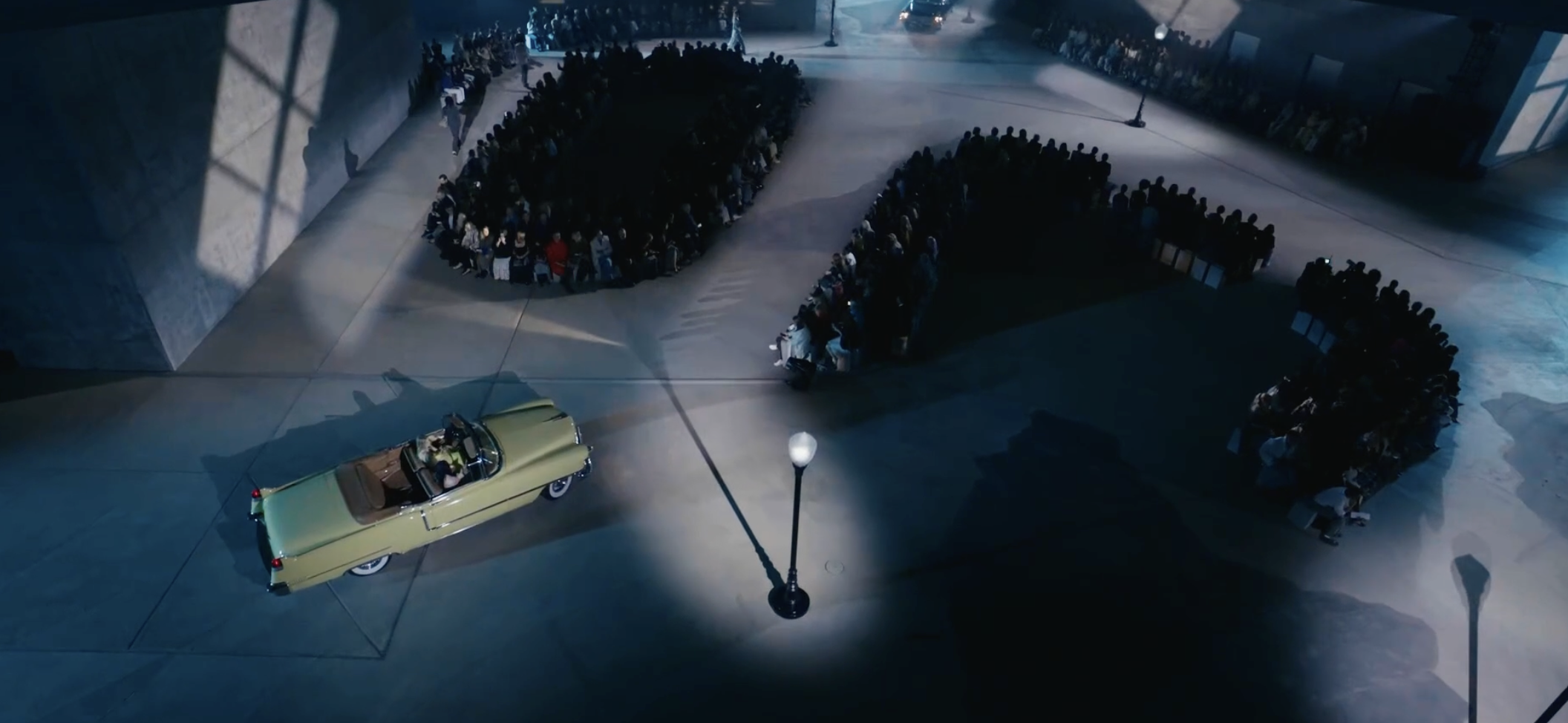
Marlene Dietrich wore the starting point in a Hitchcock film. Guests received a screenplay before the show began. Air opened and closed the night. Last night at LACMA, seventy years of Dior and Hollywood culminated into one courtyard.
In 1950 Marlene Dietrich wore a Christian Dior Haute Couture jacket in Alfred Hitchcock’s Stage Fright. The film features Dietrich performing Cole Porter’s The Laziest Gal in Town on stage, in full costume, in that specific way she had of making glamour feel slightly dangerous and slightly amused at itself simultaneously. The jacket was from Dior’s Spring Summer 1949 collection. The film was Hitchcock at his most playful and his most interested in the relationship between performance, disguise and desire.
Jonathan Anderson used that jacket as one of the starting points for his first Cruise collection for Dior, shown last night at the Los Angeles County Museum of Art. A garment from 1949, worn by Marlene Dietrich, in a Hitchcock film about deception and glamour, as the foundation for a collection shown in Los Angeles in 2026. The line from there to here is deliberate. Anderson is saying something specific about what Dior has always been, fashion and cinema and music making the same argument in different forms, across different decades, in the same conversation.
Before a single model walked, every guest at LACMA received a screenplay. Not show notes. Not a press release. A proper movie script, titled Wilshire Boulevard, set in Hollywood in 1949, formatted with scene directions and soundtrack cues and character dialogue. The opening scene has Alfred Hitchcock and Warner Bros executives negotiating with Marlene Dietrich about her role in Stage Fright. Dietrich’s line reads: No Dior, no Dietrich. The script moves through Dior’s longstanding relationship with cinema, references Lauren Bacall, Ingrid Bergman, Ava Gardner, Audrey Hepburn, Grace Kelly, Sophia Loren, Marilyn Monroe and Elizabeth Taylor, and includes a section written by Anderson himself about Christian Dior’s understanding of the dream as a form of escapism after the war. Hollywood as the Dream Factory. Fashion and cinema as the same cross-cultural shift.
Anderson did not give his audience context for the show. He gave them the show itself, on paper, before it happened.
Then Air began.
Sexy Boy opened, its bassline ricocheting across the hard concrete walls of Zumthor’s David Geffen Galleries while convertible headlights and street lamps washed over glitter-slicked gowns and metallic knits. Kelly Watch the Stars closed it, swelling through the courtyard as a dense golden light soaked the space like the final frame of an old Hollywood thriller.
Air. The duo from Versailles whose 1998 debut Moon Safari remains one of the most complete artistic statements of that era, a record that sounds like driving through a city at night with the windows down, like desire and melancholy and irony arriving simultaneously. A record that has soundtracked a very specific idea of romantic Los Angeles that never quite existed and has always been exactly right. Sexy Boy plays in the famous scene in Ten Things I Hate About You where Heath Ledger serenades Julia Stiles on the school bleachers in 1999, the moment where a French electronic track became the sound of American teenage longing and nobody questioned it because it was simply correct.
Anderson chose it for Dior at LACMA in 2026 and it was simply correct again. The French house. The French music. The Los Angeles setting. The Hitchcock reference. The Marlene Dietrich jacket. All of it pointing toward a very specific quality of glamour that is sophisticated enough to know it is glamour and secure enough not to apologise for it.
Dior’s own Instagram post of the collection has a different quality entirely. The video moves through the looks to John Lee Hooker’s Coming to Town from The Hot Spot, Dennis Hopper’s 1990 neo-noir film with a soundtrack recorded by Hooker alongside Miles Davis, Taj Mahal and Roy Rogers. Swampy, sparse, deeply American blues that sounds like heat haze and moral ambiguity and a particular kind of dangerous Californian afternoon. Whether Anderson chose it deliberately as an extension of the show’s Los Angeles noir world or whether it is simply what cleared for Instagram rights is an open question. But it works either way. John Lee Hooker over Dior on Wilshire Boulevard. The Dream Factory and the Delta blues in the same frame. Anderson’s version of this house keeps finding new ways to sound exactly right.
The Hitchcock thread runs deeper than a visual reference. Stage Fright is about performance and disguise, about a woman who pretends to be someone else in order to find out the truth, about the way glamour functions as both armour and deception simultaneously. Dietrich plays a musical theatre star. The Cole Porter song she performs is called The Laziest Gal in Town. The whole film asks what a beautiful surface conceals and what it reveals depending on who is doing the concealing.
Anderson is a designer who has always been drawn to exactly that question. Taking a 1949 Dior jacket worn by Marlene Dietrich in a film about deception and glamour and placing it at the centre of a collection shown in Los Angeles in 2026 is asking the same question in a new context. The screenplay handed to guests before the show had Dietrich saying No Dior, no Dietrich. The clothes on the runway answered her.
The audience last night included Anya Taylor-Joy, Sabrina Carpenter, Taylor Russell, JISOO from BLACKPINK and the musician Role Model, seated in the LACMA courtyard among pink convertibles and street lamps while Air played and models moved through the space like characters in a film nobody had made yet.
The show took place against the backdrop of the newly opened David Geffen Galleries, Zumthor’s first project in the United States, a sweeping sculptural building that stretches across Wilshire Boulevard and has already established itself as one of Los Angeles’s most important architectural landmarks. Fashion and architecture and cinema and music, all in the same courtyard, all in conversation.
Dior has a long history with Hollywood. Jennifer Lawrence and Mikey Madison both wore Dior to accept their Oscar for best actress. The house’s relationship with Los Angeles runs deep and long and is woven into the specific fantasy the city has always represented for French fashion, a version of glamour that is warmer and looser and less formal than Paris but no less considered.
Anderson knows all of this. His choice of Air, his starting point of Marlene Dietrich in Stage Fright, his decision to bring Dior to LACMA rather than somewhere more obviously fashion, the screenplay handed to guests before a single look appeared, all of it is the work of a designer thinking seriously about what a house means and where it can go.
When the last model disappeared into the synthetic sunset and Kelly Watch the Stars faded out, the show ended the way a film ends. With credits. The names rolled across the space the way they roll across a screen, the whole evening reframed in that final moment as a complete cinematic work rather than a seasonal collection. A screenplay handed out at the beginning. End credits at the close. Air playing throughout. Marlene Dietrich’s jacket from 1949 somewhere in the lineage of every look that passed.
You could say that Jonathan Anderson technically made a film and the clothes were in it.